Every day, millions of kilograms of food are wasted throughout the food supply chain from harvesting and distribution to traditional markets, all the way to the household dinner table. Ironically, amidst this abundance of food waste, Indonesia still faces the challenge of relying on imported feed ingredients and the high cost of feed for livestock farmers.
This phenomenon illustrates the paradox that continues to plague our food system: rich resources are being wasted, while the livestock sector struggles to find affordable and sustainable feed ingredients. This is where the concept of utilizing food waste as animal feed finds relevance—not simply an effort to reduce waste, but a crucial strategy towards a more crisis-resilient, efficient, and environmentally friendly food system.
Several studies have shown that food waste has great potential to be converted into animal feed with adequate nutritional value, provided it undergoes proper and safe processing (Nath et al., 2023).
This effort aligns with the global shift toward a circular economy, which prioritizes sustainability through resource reuse. Instead of allowing food waste to rot in landfills and produce methane emissions, it can be processed into chicken and duck feed, even technology-based feed like the currently popular maggot feed. More than just a technical solution, this idea encourages a shift in the way waste is perceived: it’s not something dirty and useless, but rather an asset that can support the livestock sector and extend the shelf life of food itself.
FLW Hierarchy and the Strategic Role of Food Waste Utilization
Within the Food Loss and Waste (FLW) hierarchy, the best strategy is to prevent waste from occurring in the first place. However, in reality, a significant amount of food is still wasted despite preventative measures. This is where utilizing food waste as feed sits at a high level of the hierarchy better than compost or energy, but still below human consumption.
This approach is considered strategic because it maintains the nutritional and energy value of food within the biological cycle. Research shows that transforming food waste into animal feed can reduce pressure on conventional feed ingredients and reduce environmental burdens (Simmons et al., 2023).
When food waste enters the livestock sector, it diverts the flow of materials that would otherwise end up as waste into useful resources. The FLW hierarchy emphasizes that upcycling—not just recycling—is the more valuable approach.
Utilizing food waste for feed not only keeps organic materials out of landfills but also encourages the implementation of a more circular food system, where no part is ever truly lost. Furthermore, this approach helps reduce dependence on imported feed, which is vulnerable to price fluctuations and geopolitical disruptions. For an agricultural country like Indonesia, this is not only an environmental solution but also a smart and realistic food security strategy.
Read more: My Waste, My Responsibility: Building a Clean Environment Starts from Home
Nutritional Potential of Food Waste as Animal Feed
Many people consider food waste unfit for consumption for both humans and animals. However, various studies show that food waste still has significant nutritional value. Waste from vegetables, fruit, bread products, leftover rice, and even unused meat scraps is often rich in carbohydrates, fiber, protein, vitamins, and minerals.
According to Georganas et al. (2020), food waste even contains various bioactive compounds that can improve livestock health and performance when converted using the right procedures.
On the other hand, certain types of waste such as vegetable and fruit waste have been shown to improve the quality of livestock products. A study by Sarmiento-García et al. (2023), for example, showed that the addition of certain vegetable wastes can improve egg quality and the antioxidant capacity of poultry.
This potential opens up a wider scope for innovation: waste is not only a low-cost solution but can also be used as a functional feed ingredient that improves livestock performance.
However, the nutritional characteristics of food waste vary widely. Its composition depends on the type of food, storage method, and duration of decomposition. Therefore, the selection of ingredients and processing technology are crucial factors in determining feed safety and quality.
Proper processing can stabilize nutrients, eliminate pathogens, and make the waste safe for livestock consumption. In other words, the nutritional potential of food waste is more than just theory it becomes very real when combined with the right processing technology.
Technology for Processing Food Waste into Animal Feed
Processing technology is at the heart of all efforts to utilize food waste as feed. Without the right technology, food waste can harbor pathogens or contain hazardous substances. Conversely, good technology can transform seemingly worthless waste into high-quality feed ingredients.
One widely researched method is fermentation. Fermentation helps improve nutrient stability, reduce moisture content, and suppress the growth of pathogenic microbes. Ng and Ismail (2020) demonstrated that two-stage fermentation can improve the quality of waste-based feed, making it safer, more easily absorbed, and with more controlled nutritional content.
Besides fermentation, another rapidly developing technology is bioconversion using Black Soldier Fly (BSF) larvae, or maggots. Maggots can convert organic waste into protein-rich biomass in just a few days.
A study by Dzepe et al. (2023) demonstrated that bioconversion with maggots is not only effective in recycling waste but also produces high-value alternative feed for chickens and other poultry. This technology is gaining popularity because it is environmentally friendly, fast, and does not require high-tech equipment.
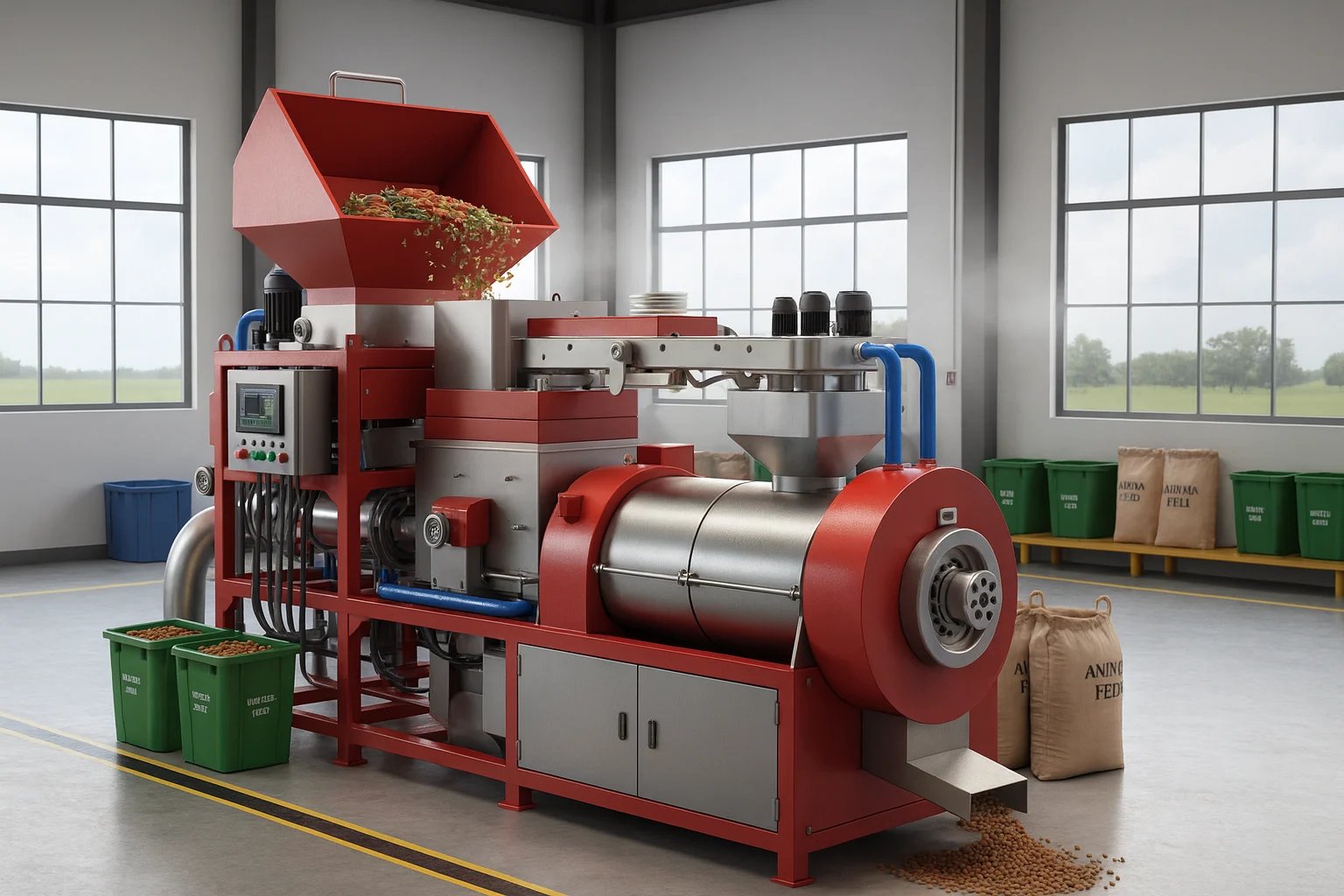
Finally, thermal drying and mechanical processing technologies such as shredding and pelletizing also play a crucial role. These processes help increase shelf life, facilitate distribution, and enable more consistent feed formulation.
Öztürk (2025) emphasized that the integration of technologies—including fermentation, drying, and bioconversion—is key to optimizing food waste utilization in modern livestock systems. With the right combination of technologies, food waste can be transformed from a burden into a highly potential resource.
Environmental, Economic, and Food Security Impacts
Utilizing food waste as animal feed offers significant environmental benefits. Instead of rotting in landfills and producing climate-damaging methane gas, food waste converted into feed can drastically reduce greenhouse gas emissions.
Nath et al. (2023) emphasized that food waste upcycling plays a crucial role in reducing the carbon footprint of the global food system. Economically, this approach can reduce feed costs, which typically account for 60–70% of total livestock production costs. When livestock farmers have access to cheaper yet nutritious alternative feeds, their well-being and business sustainability improve.
From a food security perspective, transforming food waste into feed is a smart strategy. Vlaicu et al. (2024) explain that providing sustainable alternative feed is a crucial element in achieving the “Zero Hunger” target.
By reducing dependence on imported feed ingredients such as corn and soybeans, countries can strengthen the stability of animal food production. This is especially important given that global feed price volatility can impact poultry production and its derivatives.
This approach also encourages the creation of a more resilient local economy. Food waste processing can create new jobs, increase the economic value of waste, and create synergies between the agricultural, livestock, and processing industries. Ultimately, utilizing food waste as feed is not only a technical solution but also a sustainable development strategy that addresses three key aspects: environmental, economic, and social.
Challenges and Future Directions
Despite its significant potential, utilizing food waste as animal feed still faces several challenges. One of these is safety standards. Not all food waste is safe for livestock consumption without proper processing.
The risk of contamination with bacteria, fungi, or chemical residues is a significant concern. Clear regulations are needed to prevent this practice from causing health problems. Furthermore, logistical challenges arise: food waste is distributed on a small scale in households and restaurants, necessitating an efficient collection system.
Another challenge is acceptance by the public and livestock farmers. Many still view waste as dirty and unhygienic. However, with the right technology, food waste can be turned into highly nutritious feed.
Education and practical demonstrations are needed to convince livestock farmers and encourage them to adopt this method. On the research side, the future offers numerous opportunities.
The development of more efficient bioconversion technologies, fermentation innovations using local microbes, and more stable waste-based feed formulations are the focus of future research. Simmons et al. (2023) emphasized that the integration of animal nutrition, microbiology, and food technology is essential to encourage more widespread utilization of food waste.
With a comprehensive approach—from policy and technology to public education—the use of food waste as animal feed can become mainstream in a sustainable food system. Future generations have the opportunity to witness a significant shift: from a wasteful, linear system to a more equitable and resilient, circular one.
Conclusion
Utilizing food waste as animal feed is one of the most promising strategies to address the challenges of the modern food system. By combining technology, policy, and behavioral change, food waste can be transformed into a resource that supports livestock farming, reduces carbon emissions, and strengthens national food security.
The eight studies that form the basis of this paper demonstrate that food waste transformation is no longer an abstract idea, but a concrete solution already implemented in various countries and with the potential for further development in Indonesia.
Amid the urgency of the food crisis and climate change, small steps like processing food waste can have a significant impact on the future. In a world increasingly demanding resource efficiency, this solution is more than an option; it is a necessity.
Author: Vannisa Wulandari
Postgraduate Student of Food Science, IPB University
Also active as Quality Assurance Specialist at PT Sentrum Sarana Industri
References
- Nath PC, Patoari P, Rajbongshi P, Agarwala N, Talukdar N, Sarma A, Gohain B. (2023). Valorization of food waste as animal feed: A step towards sustainable food waste management and circular bioeconomy. Animals, 13(8):1366. https://doi.org/10.3390/ani13081366
- Simmons CW, et al. (2023). Incorporation of recovered food and food scraps into poultry feed: A systematic review. CABI Reviews, 18(004). https://doi.org/10.1079/cabireviews.2023.0048
- Vlaicu PA, Leahu A, Untea AE, Turcu RP. (2024). Sustainable poultry feeding strategies for achieving zero hunger. Agriculture, 14(10):1811. https://doi.org/10.3390/agriculture14101811
- Öztürk M. (2025). Livestock-mediated food waste conversion. Notulae Botanicae Horti Agrobotanici Cluj-Napoca, 53(1):14683. https://doi.org/10.15835/nbha53314683
- Ng Chun, Ismail Fattah. (2020). Conversion of food waste via two-stage fermentation to controllable chicken feed nutrients by local isolated microorganism. International Journal of Recycling of Organic Waste in Agriculture, 9:393–404. https://doi.org/10.30486/ijrowa.2020.671208
- Georganas A, Lakovidou G, Mitsagga C, Symeon G, Goliomytis M, Deligeorgis S. (2020). Bioactive compounds in food waste: A review on the transformation of food waste to animal feed. Foods, 9(3):291. https://doi.org/10.3390/foods9030291
- Sarmiento-García A, Sandoval-Castro CA, et al. (2023). Reuse of vegetable wastes in animal feed: The influence of red beet powder supplementation on performance, egg quality, and antioxidant capacity of layer quails. Tropical Animal Health and Production, 55:259. https://doi.org/10.1007/s11250-023-03556-w
- Dzepe D, Nchanji GE, Djonme NT, Tchuinkam T. (2023). From agricultural waste to chicken feed using insect-based technology. Basic and Applied Zoology, 84:22. https://doi.org/10.1186/s41936-023-00339-5
Editor: Salwa Alifah Yusrina
Bahasa: Rahmat Al Kafi