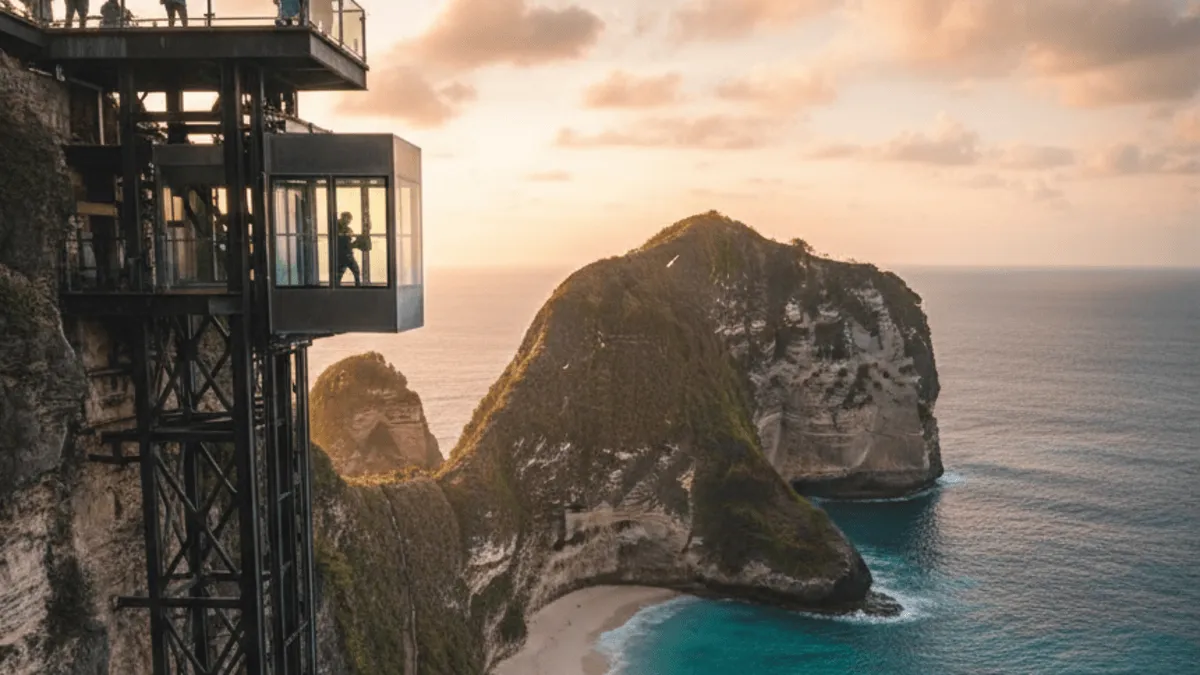
The 182-meter-high Glass Elevator project on the cliffs of Kelingking Beach, Nusa Penida, represents a major ambition to establish Bali as a world-class ultra-premium tourism destination.
This infrastructure is projected to provide easier access for visitors while strengthening Kelingking’s appeal as an international tourism icon.
As cited from the website dutapariwisataindonesia.com in an article titled “Maintaining a Balance between Accessibility and Environmental Sustainability at Kelingking Beach,” the improvement of accessibility must go hand in hand with efforts to protect the fragile karst ecosystem, so that the natural panorama serving as the main attraction is not eroded by development.
With the potential to generate billions of rupiah in foreign exchange from high-end tourists, this project could become an economic catalyst for the Nusa Penida area and Bali more broadly.
The presence of new infrastructure is expected to extend tourists’ length of stay, broaden visitor segmentation, and stimulate supporting sectors such as transportation, accommodation, and local tourism-related businesses.
If managed properly, the Glass Elevator could strengthen Bali’s position amid increasingly intense competition among international destinations.
However, these benefits can only be realized through consistent oversight. Large- scale projects inevitably carry consequences, especially when developed in areas with strong natural characteristics.
Without careful management, development intended to improve accessibility may instead give rise to new problems that ultimately harm the image of tourism itself.
This situation makes the Glass Elevator project difficult to view in a simple manner.
While development ambitions promise economic benefits, the location context and social character of Nusa Penida demand a more cautious approach.
This is where the balance between development and protection becomes a key issue. Kelingking Beach has long been known for its captivating natural beauty.
Steep cliffs and fragile karst rock structures make this area both visually appealing and vulnerable.
Large-scale construction activities have the potential to trigger physical environmental changes, ranging from erosion to disruption of the coastal ecosystem.
If these impacts are not managed seriously, the natural values that have long been a key driving force of Nusa Penida’s tourism could be slowly eroded.
Beyond environmental issues, public concern is also focused on the long-term sustainability risks of the project.
Experience in various regions shows that large-scale tourism infrastructure does not always proceed as planned.
Technical constraints, changing tourism trends, and weak operational planning often cause projects to be halted before they achieve their full potential.
When structures are left abandoned, the impact not only damages the landscape but also leaves a negative impression on destination management.
For an area as iconic as Kelingking, such risks cannot be ignored. The presence of large cliff structures will always be part of the landscape.
If they are not maintained or functional, their presence could potentially diminish the very appeal they were intended to enhance.
Therefore, long-term commitment from investors and the government is key to ensuring the project’s sustainability.
Management certainty, including operational aspects, needs to be a priority from the outset.
A clear maintenance plan will help ensure that the infrastructure built does not become a visual or social burden.
This approach is also crucial for maintaining the trust of tourists, who are increasingly concerned about the sustainability of the destinations they visit.
Beyond technical and environmental issues, the success of the Glass Elevator is also largely determined by local community acceptance.
Tourism development has often outpaced the engagement of surrounding residents. Economic benefits are not always shared equally, while social impacts are directly felt by local communities.
This inequality has the potential to create a distance between the project and its residents. The Glass Elevator offers the opportunity to adopt a more inclusive approach.
Community involvement from the planning stage can foster a healthier dialogue. Partnerships with Village-Owned Enterprises (BUMDes), business opportunities for local residents, and open communication with traditional villages can strengthen a sense of ownership of the project.
When residents feel involved, development is no longer viewed as an external project but as part of a shared effort.
This involvement can also be realized through economic activities closely related to the community’s daily lives.
The provision of tourism support services, local product development, and creative economic activities in the surrounding area can all become part of the project’s ecosystem.
In this way, the Glass Elevator’s presence does not stand alone but is directly connected to the economic pulse of the Nusa Penida community.
Transparency is crucial for maintaining these relationships. Open information regarding development stages, potential impacts, and environmental management measures can help alleviate public speculation and concern.
Such transparency demonstrates that tourism development is being pursued with mutual interests in mind, not solely for economic reasons.
Consistent environmental management also underpins tourist confidence. Regular environmental impact monitoring will demonstrate that tourism development in Nusa Penida is not being carried out haphazardly.
Amid growing global awareness of sustainability issues, this commitment can strengthen Bali’s image as a responsible destination.
The experience of many destinations shows that major tourism projects rarely fail due to a lack of ideas or technology. Problems often arise when public trust wanes midway.
In this context, the future of the Glass Elevator depends heavily on how the project is managed, communicated, and perceived by the surrounding community.
If a careful and inclusive approach is truly implemented, the Glass Elevator has the potential to become more than just a means of tourist access.
This project can serve as an example of how tourism ambitions can be managed without sacrificing nature and social life.
Tourism growth doesn’t always have to be at odds with sustainability, as long as balance is the key.
Ultimately, Bali’s biggest tourism challenge lies not in a lack of big ideas, but in the ability to manage ambitions in harmony with environmental and social carrying capacity.
The Glass Elevator project in Nusa Penida is a crucial test. Whether it will be remembered as a step forward toward more inclusive tourism, or simply a record of ambitions that went beyond balance, will largely depend on the choices made today.
Writers:
1. Eka Wahyuning Istiqomah
2. Edrea Regina RBB
3. Priselly Andharexcy
4. Intan Mei Brisqia
Student of International Relations, Universitas Teknologi Yogyakarta
Supervisor: Hidayat Chusnul Chotimah, S.I.A., M.A.
Editor: Siti Sajidah El-Zahra
Copy Editor: Rahmat Al Kafi