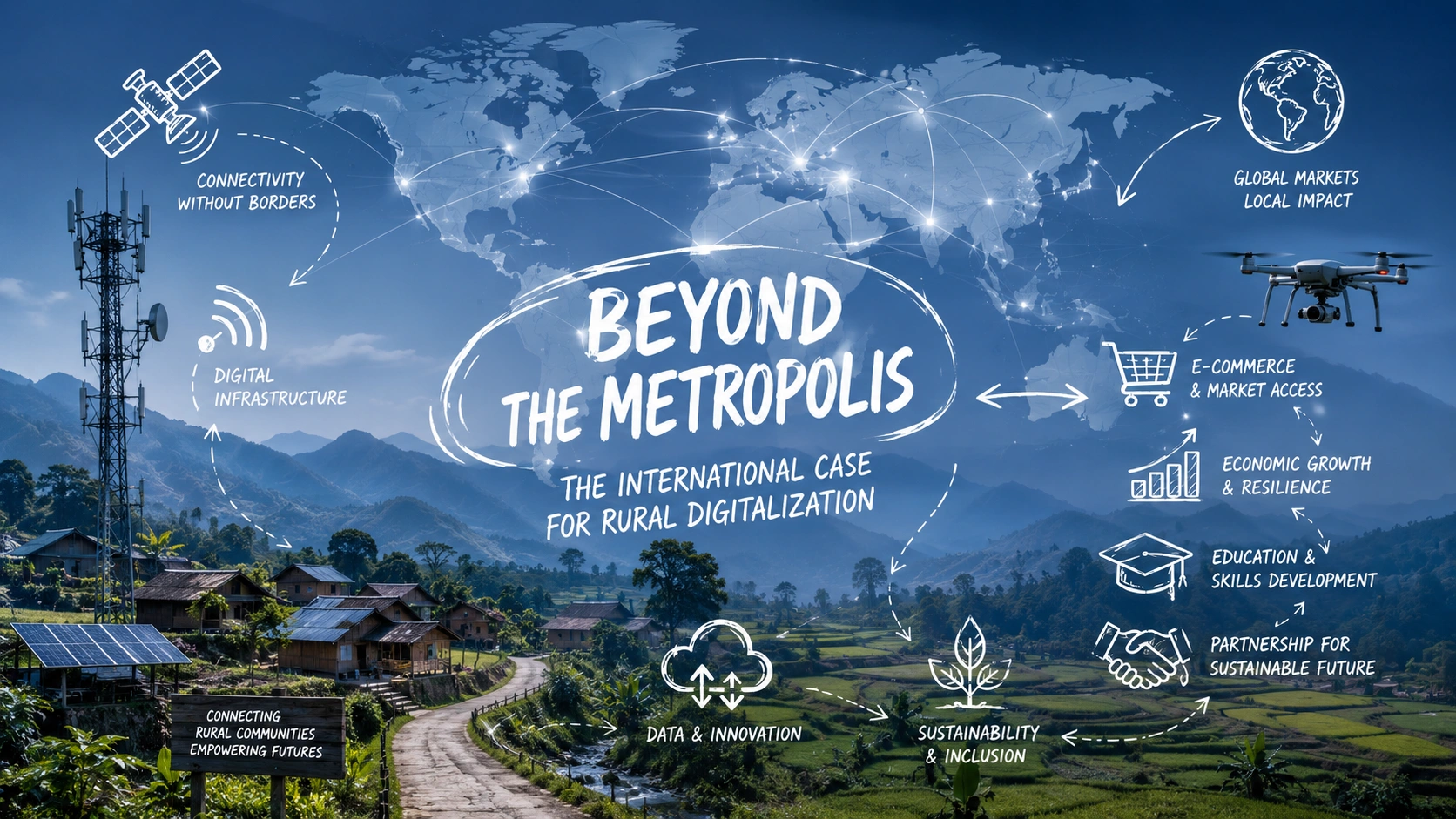
Conceptual Framework and Key Terminology
To understand the imperative of rural digitalization, it is necessary to establish a shared conceptual framework.
Rural digitalization refers to the systemic deployment of broadband infrastructure and the integration of digital tools, such as cloud-based management systems, e-commerce platforms, and decentralized data analytics, into the economic and social fabric of non-metropolitan regions.
Information asymmetry, as established in the seminal work of Akerlof (1970) and further expanded by Stiglitz (2002) in the context of development economics, represents a market failure where one party possesses superior data, historically forcing rural producers to accept suboptimal prices from dominant intermediaries.
Finally, endogenous growth theory, as formalized by Romer (1986) and Lucas (1988), posits that economic growth is primarily the result of internal processes, such as investments in human capital and knowledge acquisition. This theory suggests that digitalization acts as a critical catalyst for self-sustaining regional development.
The Dynamics of Global Connectivity
When discussions about global digitalization arise in international forums, the narrative often centers around smart cities, artificial intelligence, and the seamless connectivity of urban financial hubs. However, looking at this shift through the lens of international relations and global development reveals a critical reality. The true test of the global digital transition lies not in the skyscrapers of metropolitan centers but in the remote villages of developing nations.
For the international community, rural digitalization is not a luxury or a mere lifestyle upgrade. It is an urgent global imperative that directly impacts supply chain resilience, economic equity, and the realization of the United Nations Sustainable Development Goals (SDGs).
The scale of the global digital divide remains one of the most pressing challenges in contemporary international development. According to data from the International Telecommunication Union (ITU, 2023), approximately 2.6 billion people worldwide remain completely offline, with the vast majority residing in rural communities.
This isolation creates acute economic vulnerability. In many developing regions, local producers and rural enterprises are the backbone of the economy. Yet, due to a profound lack of market data, these communities are frequently forced to navigate complex global supply chains blindfolded, leaving them vulnerable to predatory intermediaries.
Digitalization shatters this isolation and actively shifts the balance of economic power. By utilizing digital platforms to establish transparent supply chains and showcase their local business models, rural enterprises can directly negotiate with international buyers. As documented by Deichmann et al. (2016), the ability of rural producers to access real-time market data is the single most significant factor in closing the productivity gap between rural and urban economies.
The success of this digital transformation relies heavily on comprehensive human capital development. Providing internet infrastructure is only the first step. The real breakthrough happens when rural communities receive targeted training in digital management, e-commerce, and localized logistics.
By prioritizing skill building at the grassroots level, a new generation of capable innovators can emerge, viewing their hometowns not as places to escape from but as strategic centers of opportunity.
Ultimately, integrating digital technology into rural regions is a powerful catalyst for long-term stability. When the international community invests in rural digital infrastructure, young professionals no longer need to migrate to overcrowded urban centers to build a secure future. Armed with digital literacy, they can establish localized hubs, manage advanced processing, and seamlessly connect their villages to the broader global market. This systemic shift transforms rural areas from vulnerable extraction points into independent industrial centers.
Economic Resilience and Market Integration
Beyond driving daily economic growth, rural connectivity is essential for managing broader international market shocks. Small regions are frequently the most exposed to global economic downturns and sudden supply chain disruptions.
Studies from the World Bank (2022) indicate that expanding mobile broadband coverage in rural areas can reduce poverty by up to 7 percent and significantly improve local economic adaptability. With reliable connectivity, local enterprises can quickly pivot their strategies when international demand shifts. They can access digital financing, form online cooperatives to share logistical costs, and tap into alternative markets without relying on physical middlemen.
A digitally connected village is inherently more agile, possessing the necessary tools to absorb economic shocks and maintain sustainable growth even when traditional trade routes face disruptions.
The expansion of digital networks creates a profound ripple effect that extends well beyond local commerce by facilitating an unprecedented exchange of technical and institutional knowledge across borders. This peer-to-peer knowledge transfer is essential for modernizing rural industries at an accelerated pace, as it allows local leaders to adopt sophisticated logistics models and sustainable techniques that have proven successful in other parts of the world.
By integrating these global insights into their local operations, rural enterprises can drastically reduce their learning curve, minimize trial-and-error costs, and position themselves as competitive players in a specialized, quality-driven global market. As highlighted in research by Castells (2010) on the rise of the network society, digital platforms allow for the decentralization of expertise, which is essential for empowering remote communities to participate in global value chains.
From a theoretical standpoint, the deployment of rural digital infrastructure functions as a critical mechanism for internalizing economic value. By reducing information asymmetry, digitalization enables local actors to capture a higher percentage of the final retail price, thereby reversing the historical trend of value extraction by intermediary entities.
This structural change aligns with the principles of endogenous growth theory, which suggests that decentralized technological adoption is a primary driver of sustainable productivity gains. Furthermore, the ability to utilize digital monitoring tools allows rural enterprises to meet increasingly stringent international standards for sustainability and traceability. These digital protocols provide the empirical verification required for rural products to access premium global markets, thereby validating the economic rationale for continued investment in rural connectivity.
Moreover, the scalability of digital solutions in rural contexts provides a unique opportunity for institutional strengthening. Through the adoption of cloud-based management systems and decentralized ledger technologies, rural cooperatives can achieve levels of administrative transparency and operational efficiency previously reserved for large corporate entities.
This institutional modernization facilitates better access to formal credit markets, as digital transaction histories provide the verifiable data needed for financial institutions to assess risk and extend capital. Consequently, digital inclusion acts as a foundational element for broader institutional development, enabling rural regions to integrate more deeply into national and international governance frameworks.
As noted by Acemoglu and Robinson (2012), inclusive institutions are the primary drivers of long-term prosperity, and digital tools provide the necessary infrastructure to build these institutions at the grassroots level.
Finally, the shift toward rural digitalization necessitates a robust analytical framework for evaluating the multidimensional impact of connectivity on community welfare. Beyond direct economic indicators, digitalization significantly improves access to essential public services, including distance learning and specialized vocational training.
This expansion of service delivery is critical for developing a resilient workforce capable of adapting to the rapidly changing demands of the international economy. By fostering an environment where digital literacy and professional training are readily accessible, governments and international organizations can create a self-reinforcing cycle of improvement that spans generations.
This multigenerational impact is perhaps the most significant benefit of digital investment, as it ensures that the advantages of the global digital transition are not merely temporary but form the basis for permanent improvements in the quality of life for rural inhabitants.
This paradigm of rural connectivity fundamentally necessitates a shift in how international development is conceptualized and executed. Rather than viewing rural regions as peripheral entities requiring external aid, international policy must increasingly treat these areas as dynamic nodes of innovation and industrial production.
The strategic deployment of digital resources, when coupled with a commitment to locally driven governance, allows for the creation of autonomous industrial models that can compete on equal footing with urban centers. This transformation is not merely about closing a technology gap but about redefining the spatial organization of global economic activity to ensure greater inclusivity and resilience.
In a world characterized by increasing interconnection, the ability of rural communities to fully participate in the digital economy is the ultimate metric of a truly global and equitable development strategy.
International relations in the modern era must recognize that true global resilience cannot be achieved while billions of people remain disconnected. By prioritizing rural digital inclusion, the international community does more than close a technology gap. It empowers local entrepreneurs, protects global supply chains, and builds a fairer, more integrated world where no community is left invisible in the dark.
Writer: Rizky Abdilah (NIM: 106218053)
International Relations Student at Pertamina University